

Conflict and Resolution
On first listen, the music on Yes’s 1974 album, Relayer, is impenetrable. The chaotic introduction to “Sound Chaser,” the battle sequence of “Gates of Delirium,” and the absurdity of “chau, chau, chaus” on a progressive rock album render Relayer’s music impossibly dense, jagged, angular and alien to anything the band had ever done previously. New keyboardist Patrick Moraz, having replaced Rick Wakeman after his departure in May 1974, brought a jazz and improvisational sensibility to the band that was, for many Yesfans, shocking in its tonal and melodic approach, particularly after the musical pastoralism of Tales From Topographic Oceans (TFTO). The Relayer era, lasting barely two years in the band’s 57-year history, arguably represents Yes’s most conflictive yet creative, distinctive, and accomplished work.
A first hearing will reveal forty minutes of wildly diverse, initially unrecognizable, but intriguing music. Relayer followed the song template established on Yes’s brilliant 1972 release Close to the Edge (CttE): the masterwork, the up-tempo rocker, and the soothing pop/love ballad. After closer inspection, however, the music becomes more melodic, understandable, and completely unique in the Yes canon. How Relayer came to be and why the band didn’t follow the musical path it blazed on the album is one of Progressive rock’s more fascinating tales.
Relayer’s story starts in the fall of 1973. Advance orders for Tales From Topographic Oceans (released in December 1973) had already guaranteed it gold disc status. The UK tour set to begin in November was nearly sold out and advance sales for the winter/spring 1974 American leg had forced the dates into the largest venues Yes had ever played.
Meanwhile, vocalist Jon Anderson had been listening to a couple of new albums and contemplating follow-up musical projects. “Sing Me A Song Of Songmy” by Turkish American composer Ilhan Mimaroglu, its eclectic mix of electronica, avant-garde compositions, and trumpeter Freddie Hubbard’s jazz quintet expanded Anderson’s mind more than any weed or LSD could. Vangelis Papathanassiou’s soundtrack album, the exotic, lush, and textured “L’Apocalypse des Animaux,” but stylistically the polar opposite of Mimaroglu’s record also captivated Anderson, whetting his creative drive.
But changes, percolating for some time, were coming to Yes. The first signs of conflict surfaced on November 24th, when Rick Wakeman, whose dissatisfaction with the band’s direction after TFTO and an increasingly lucrative solo career (his debut solo album, The Six Wives of Henry VIII having been released the previous January), announced that he was leaving the band. Though he was eventually persuaded to finish the TFTO tour, Wakeman and the band’s fate was set. Barely a week later during a show in Manchester, UK, the infamous onstage curry incident took place and following the 1974 European tour leg, on May 18th, Wakeman officially left Yes.
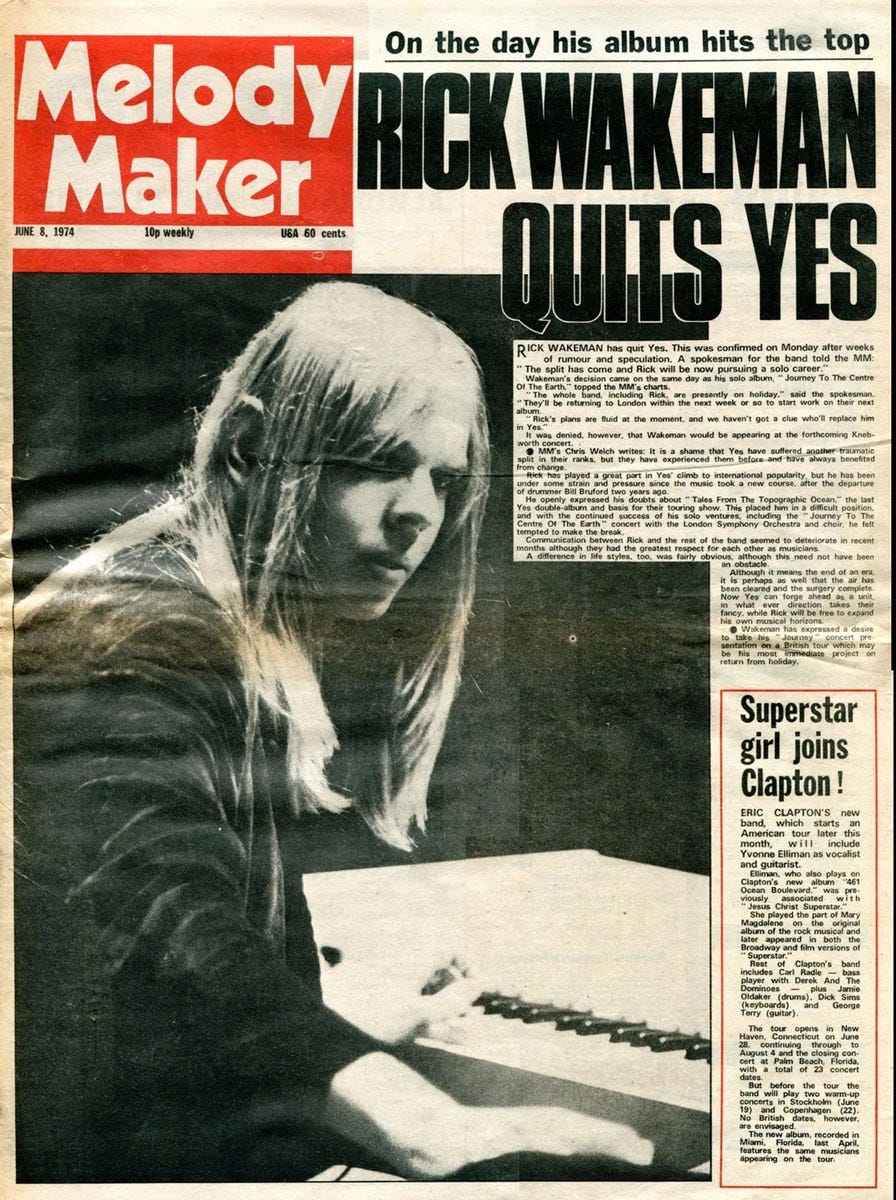
Faced with replacing Wakeman (as if that was actually possible), some well-known names were floated as possibilities: Jean Roussel, Eddie Jobson, Nick Glennie-Smith. Even Keith Emerson was mentioned as a possibility, prompting the rather incredulous response, “Why do I need to join Yes when I have ELP?” Vangelis, agreed to audition, as well, shipping his keyboard rig to the rehearsals at Farmyard Studios in Little Chalfont, Buckinghamshire. However, the band quicky realized the collaboration with the keyboardist wouldn’t work. Guitarist Steve Howe recalled how Vangelis would not have been a good fit. “When we said let’s play that again, he’d say, ‘Well it won’t be the same.’ He was always going to play off the cuff which would have been wonderful, but we’re not a jazz group.”
In July 1974, Melody Maker reporter Chris Welch made a novel suggestion: Swiss keyboardist Patrick Moraz. With a background in jazz and classical music, the Refugee (a progressive and jazz fusion trio) member accepted an invitation from Yes manager, Brian Lane, to audition in August. Accustomed to the financial strain of hourly studio rentals, watching the other band members arrive in their expensive cars and the leisurely pace of the proceedings was a bit overwhelming: “Coming from Refugee, where we had been walking three miles to and from our rehearsal place ... it was quite a contrast!”
Despite Wakeman’s exit, and prior to Moraz’s entry, Yes had already begun composing and rehearsing new material. With space to move forward with a new approach, more attuned to the musical moment, Patrick Moraz seemed a perfect fit for the band. Rather than flamboyant and symphonic flourishes characteristic of the band’s approach, the revamped Yes embraced madness and chaos, fearlessness and experimentation. Averting conflict seemed possible after all.
Sound Chaser
Moraz had been a Yesfan since meeting the original line-up in 1969 and his eagerness at the opportunity to join the band showed. Using Vangelis’s keyboards (which had remained in the studio), Moraz played a number of parts including a section of “And You and I,” prompting the band to play closer attention. “I was improvising, showing a bit of my speed and ability, and they stopped talking and all gathered around the electric piano and the Moog to watch and listen. I played all sorts of things, including a little bit of And You and I. To be honest, I think I got the gig at that point before we’d even played a note together.”
Moraz was then asked to add musical accompaniments to the introduction and middle vocal section of “Sound Chaser.” As if destiny had intervened, Moraz promptly came up with the electric piano arpeggio that opens the piece, coordinating with bassist Chris Squite and drummer Alan White on the complicated time signature. With tape rolling they continued to work out their parts, tentatively at first but more confidently as the song took shape. “Then we recorded the introduction in a take that was used on the finished album before I was offered the job.”
The next day, Lane formally offered Moraz the job.
“Sound Chaser” opens Side Two of the album, a performance clearly demonstrating a musical ensemble at the peak of their power. Steve Howe’s guitar solo at approximately the three-minute mark is a thing of wonder: a jagged, aggressive excursion reminiscent of John McLaughlin that doubles Moraz’s keyboard runs. Howe recalled, “Sound Chaser is like this madman from hell, an indescribable mixture of Patrick’s jazzy keyboard and my weird sort of flamenco electric, which I’m sure has never been done before and will probably never be done again!”
The Gates of Delirium
Occupying the entirety of Side One, “The Gates of Delirium” is Yes’s most adventurous and ambitious recording, both compositionally and performance-wise. Its musical and lyrical structure mirrors the conflict embodied in war. Based on Tolstoy’s War and Peace, Anderson had come up with the piece’s various themes and segments, playing them on piano “very badly” for the group. Rehearsed and recorded in sections, the song was stitched together from the strongest recordings with overdubs subsequently added. Co-producer and sound engineer Eddie Offord’s (often called Yes’s 6th member in those days) influence was undeniable: “The band would come in with ideas and bits, but songs were really developed in the studio. There was lots of experimentation – and editing.”
“Gates…” was not a political statement, however, but rather an auditory portrayal, an epic musical image. Anderson explained, “It’s a war song, a battle scene, but it’s not to explain war or denounce it. It’s an emotional description with the slight feeling at the end of ‘Do we have to go through this forever?’ There’s a prelude, a charge, a victory tune, and peace at the end, with hope for the future.”

The piece is astonishing for a myriad of reasons: Anderson’s mystical, yet paradoxically his most literal lyrics, Howe’s complex guitar parts, incorporating flamenco and feedback, Chris Squire’s bass coloring the music with its distinctive Rickenbacker feel, and drummer Alan White delivering a career defining percussive performance: “We decided that the keyboards and the drums would [be] very physical, an audible battle with one another. I put in a lot of backwards drums. The piece builds and builds and builds until that beautiful melody at the end. I actually wrote those chords on guitar, which is funny, because I don’t really play the guitar. I wrote the chords and Patrick came up with the melody.” The song’s battle section, a cacophony of melody, percussion, and explosive sound effects using discarded car parts collected from a scrap yard by White and Anderson was a vivid departure from the group’s previous epic compositions. Howe remembers, “Jon had a vision for it. He had lots of structure, and we were very impressed. A great deal of Gates was invented as a group, but from Jon’s ideas. [He] charged on and on and on. It is probably his most successful moment at leading the band towards a goal he had in mind.”

“Gates’s…” closing movement, the idyllic “Soon” encapsulates the entire contrasting and conflicting gestalt of the album. Melodies shift, mood lifts, and a hopeful relief envelopes the listener. Former Yes vocalist Trevor Horn recalled after seeing the song performed live, “I can remember when it got to the end and Jon sang Soon. I felt like crying, it got me so much.” Between Anderson’s beautiful vocals, Moraz’s ethereal Mellotron, and Howe’s spine-tingling pedal steel guitar, this song within a song is arguably Yes’s most magical composition and performance.
To Be Over
Relayer closes with the gorgeous “To Be Over.” Written by Jon Anderson and Steve Howe, the contrast with “Sound Chaser” could not be starker. Steve Howe: “It was one of my songs that Jon liked. It was quite a well-structured song. We had this abundance of rich ideas that weren’t simply knitted together in an abstract way. They were meant to be together. For me, this song has one of Yes’ best middle eights. [Jon] liked a different song I had written that started off with the lines ‘We’ll go sailing down the stream together’, and changed it to ‘calming stream’, which moved the song in a new direction.”
After the intensity of the album’s two preceding tracks, “To Be Over” is indeed a calming respite. “Calming” is doing some heavy lifting here, though. It begins as a quiet, acoustic unplugged piece growing inexorably into complex harmonies, time signatures and vocal parts. Moraz recalled, “I treated it exactly like a fugue, a classical fugue. The ending solo, I remember having written it down that very night. Suddenly, they wanted to change the key. I had to rewrite the entire thing.”
Conflict Overcome
Moraz’s addition clearly pushed the band’s music in a jazzier and more fusion-like direction. At the same, John McLaughlin’s Mahavishnu Orchestra and Return to Forever (with 20-year-old virtuoso guitarist Al Di Meola) were also crushing musical boundaries, capturing Yes’s attention. Hence, Relayer integrates that 1974 Mahavishnu/Return to Forever musical landscape that combines composition and improvisation, complex rhythms and time signatures, and the undeniable virtuosity of Yes’s players.
Released in the UK on November 28, 1974 and a week later in the US, Relayer appeared as progressive rock music was reaching its creative zenith. Yet it stood also at a musical and cultural crossroads. The hippie optimism of the 1960s had faded as the me-decade cemented its hold on popular culture. Economic uncertainty, energy crises, and the implosion of U.S. involvement in the Vietnam war produced cultural and societal upheavals that would lead to an artistic and creative revolution with the eventual appearance of the musical and social juggernauts (though polar opposites), punk and disco.
But in 1974, progressive rock music was thriving. The year saw releases from Genesis (The Lamb Lies Down on Broadway), King Crimson (Red), and, soon enough, Pink Floyd (Wish You Were Here), ambitious, experimental works that strove to expand musical boundaries and overcome their own limitations. Yes, after the mystical, lush symphonic structure of Tales From Topographic Oceans, turned to expansive, chaotic, and angular musical forms that drew on jazz fusion and the avant-garde.
Philosophically and lyrically, Relayer channels “musical structure as metaphor for human conflict” with the album’s three pieces flowing between chaos and tranquility, intensity and release. “This constant oscillation between turmoil and calm mirrored the band’s own internal dynamics—Yes was a group of perfectionists, pushing their creative process to near-collapse. The recording environment at Eddie Offord’s mobile studio in late summer 1974 was charged with pressure, experimentation, and improvisation. Each take could last hours; perfection was both the goal and the curse.”
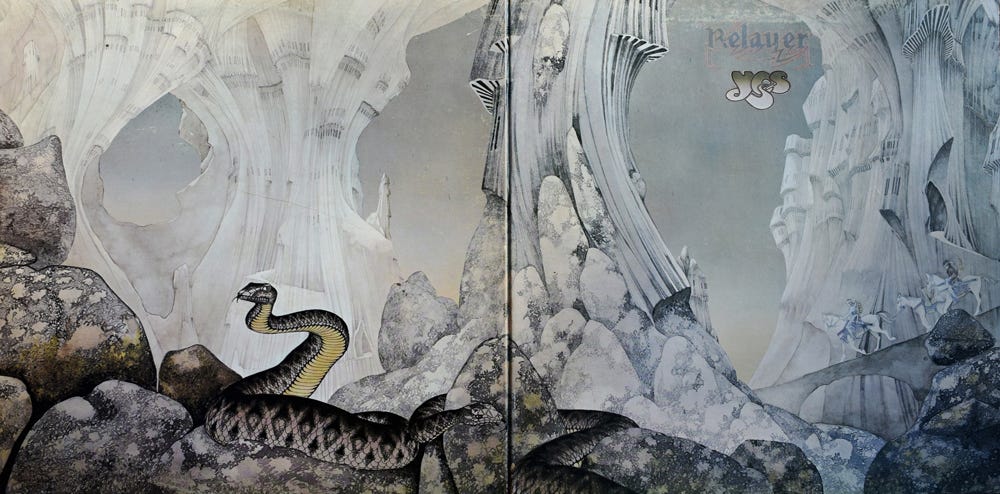
Roger Dean’s cover artwork mirrored the themes articulated in the music-a largely monochrome landscape populated with danger (snakes, armored riders, towering monoliths) and transcendence. Donald Lehmkuhl, a British poet known for his frequent collaborations with Dean, wrote the poem found inside the gatefold cover. Like the music inside, it explores legend, the cosmos, struggle, and redemption, pillars that also guided the album’s sonic and lyrical architecture.
Snakes are coiled upon the granite.
Horsemen ride into the west.
Moons are rising on the planet
where the worst must suffer like the rest.
Pears are ripe and peaches falling.
Suns are setting in the east.
Women wail, and men are calling
to the god that’s in them, and to the beast.
Love is waiting for a lover.
Generations kneel for peace.
What men lose, Man will recover
polishing the brains his bones release.
Truth conceals itself in error.
History reveals its face:
days of ecstasy and terror
invent the future that invents the race.
Donald Lehmkuhl (October 1974)
With Relayer’s release, Yes embarked on a major tour, in many ways exceeding the TFTO tour’s breadth and scope. Moraz recalled, “When we did the last three or four rehearsals at Shepperton Studios and were preparing to do our first tour of the United States, the band had around 192 flight cases and there were 53 roadies.” Touring in support of Relayer in 1975 and 1976, the group logged over 100 shows. A massive undertaking, the 192 flight cases and 53 roadies were required to construct and break down nightly the Roger and Martyn Dean-designed elaborate stage set adapted from the TFTO tour.
Concerts began with Yes’s traditional opener, an excerpt from Stravisky’s Firebird Suite. Then, improbably, the band would dive right into the demanding and, what must have been for Yesfans at the time, startling “Sound Chaser.” Alan White talked about the pitfalls of opening with that piece, “We used to open the show with “Sound Chaser,” but unfortunately it would take two or three songs for the band to settle down to any good tempo to perform because it was so fast. You got on stage and that adrenaline you’ve got is usually let out in the first number. It’s a collective unit that is playing the tempo and if one guy is playing fast, then everyone has to keep up.”
Prior to the follow-up 1976 North American tour, the band had begun writing material for the next album. As Moraz recalled, “We had written, together, quite a lot of the material which ended up on Going for the One, Awaken, Wondrous Stories or even Parallels which were as much part my composition as anyone else in the band at that time.” However, machinations were already in place to bring Rick Wakeman back into the band, eventually pushing Moraz out. Michael Tate, a Yes roadie from that period recalled that the Swiss keyboardist never really fully integrated into the band: “He never had a chance to be fully accepted…Yes is an English band and that’s all there is to it.” Patrick’s last show with Yes was August 22, 1976 in Fort Wayne, Indiana. Rick Wakeman rejoined Yes on November 4th.
Perhaps Moraz was not English enough, or Wakeman’s artistic gravitational pull was just too overwhelming, but Moraz’s departure and Wakeman’s reintegration meant a return to Yes’s traditional, orchestral and (what some might say), safe sound. With the classic lineup back (Jon Anderson, Steve Howe, Chris Squire, Alan White, and Rick Wakeman), recording for Going for the One (albeit with material that Moraz had helped develop), was completed and the album released in July 1977. A world tour followed during which no material from Relayer was performed. Disappointing for some though it signaled a return to form, Going for the One offered no experimentation or pushing of progressive rock boundaries (though it did produce Yes’s last true masterpiece, “Awaken”).

After the string of albums that defined Yes’s classic period (The Yes Album, Fragile, Close to the Edge, Yessongs, Tales…), Relayer stands as the culmination of that brilliance. Not simply another Yes album, Relayer is proof that emotional connection can exist in chaos and turmoil. That delirium can result in peace. And that overcoming conflict can produce exquisite beauty.
Additional reading:
This is a deeply considered and confident piece—rich with historical grounding, musical insight, and a genuine affection for Relayer’s risk-taking spirit. I especially appreciated how you framed the album not simply as an outlier, but as a moment where internal conflict became the creative engine. The track-level discussions are sharp without becoming technical for their own sake, and the broader cultural framing gives the album real weight beyond fandom. A thoughtful, persuasive tribute to Yes at their most fearless.
51 years. Gulp. Time flies when you're having fun. Seems like yesterday that album came out. I saw them tour it.